
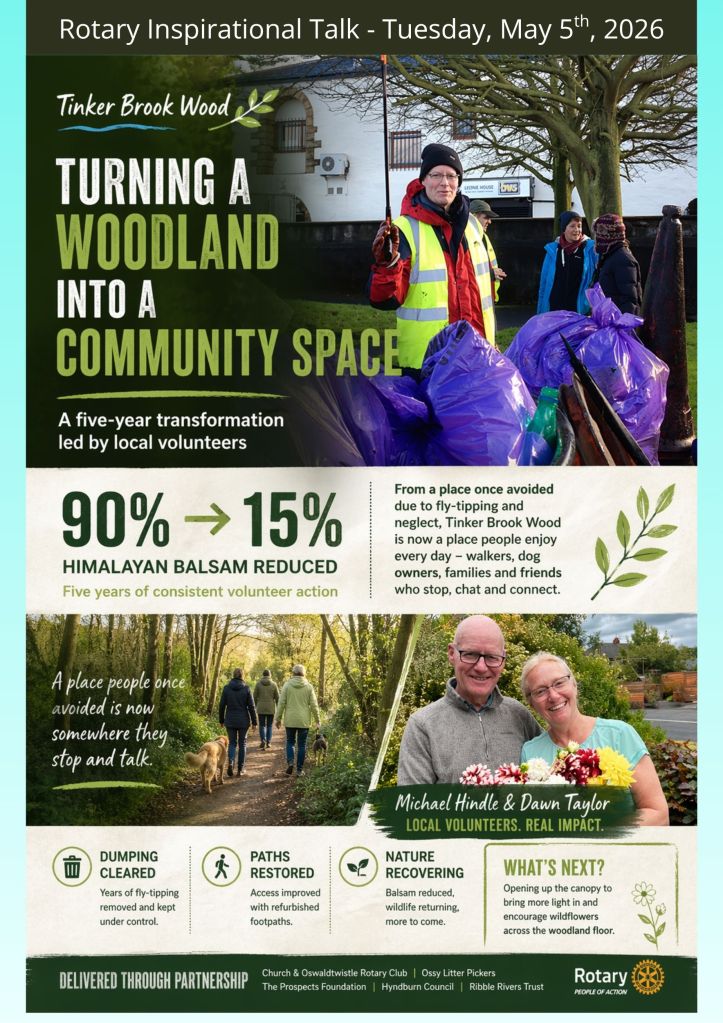
Tinker Brook Wood – Turning a Woodland into a Community Space
Michael Hindle and Dawn Taylor delivered an engaging and practical talk on the transformation of Tinker Brook Wood over the past five years. What started as a neglected and largely overlooked woodland has become a well-used community space, with clear environmental and social benefits.
How it Started
During Covid, Dawn—an active Rambler—began exploring local walking routes and came across Tinker Brook Wood. The site was in poor condition, with significant environmental issues and very little active management.
At around the same time, Rotary introduced a new area of focus: The Environment. This provided a natural opportunity to take action.
Dawn contacted Hyndburn Borough Council, where Anne Houricane (involved since the woodland was first planted in the early 1980s) became a key supporter. Together, they began tackling three core problems:
Japanese Knotweed
Himalayan Balsam
Persistent fly-tipping, particularly from nearby allotments
Early Action and Partnerships
From the outset, this was a collaborative effort involving:
Church and Oswaldtwistle Rotary Club volunteers
Ossy Litter Pickers
The Prospects Foundation (“Woody” team)
Ribble Rivers Trust
Hyndburn Council
Key early successes included:
Complete removal of Japanese Knotweed using specialist contractors
Regular, organised litter picking with agreed collection points
Significant reduction in long-standing dumped waste
Tackling Himalayan Balsam
One of the most demanding challenges has been controlling Himalayan balsam.
Originally covered around 80% of the woodland
Suppresses other plant growth
Each plant releases thousands of seeds, spreading several metres
The approach to clearing has been:
Manual pulling (“balsam bashing”)
Use of strimmers
Sustained effort over three years, often up to 20 hours per week
A key learning from the project challenged conventional advice.
Many believed balsam had to be uprooted and stamped out to be effective, and that strimming would not work. In practice, this proved not to be the case.
Michael Hindle took this on as a personal challenge, spending hours most days over a couple of summers strimming large areas of the woodland. Given the scale of the site—approximately 150m × 150m (around 5½ acres)—this approach proved essential. Without it, it is highly unlikely that such significant progress in controlling the balsam could have been achieved.
Progress has been substantial, but the work remains ongoing due to the volume of seeds already present and those carried downstream along the brook.
Environmental Improvements
A number of practical initiatives have improved both biodiversity and usability:
Wildflower meadow project
Ground prepared using yellow rattle to weaken grass
Seeds sown with support from Police Cadets
Result: a natural meadow supporting wildlife
Ash dieback management
Led by the Prospects Foundation
Around 10% cleared so far, with more to do
Increased light levels encouraging natural regeneration
Habitat features
Bird boxes installed
Hedgehog homes introduced
Brook clearance
Ribble Rivers Trust removed significant debris
Infrastructure and Access
After around three years, visible progress led to further council investment:
A main pathway refurbished, significantly improving access
A second path planned along a historic bridleway
Dead hedging introduced to form natural future boundaries
The Real Outcome – A Community Space
The most important change is not just environmental—it is social.
What was once a neglected and avoided area is now:
Regularly used by walkers and dog owners
A place where people naturally meet and chat
A valued and well-used local green space
Wider Context – Natural Control of Balsam (Research Insight)
There has been international research into natural ways of controlling Himalayan balsam. In the UK, scientists—working with organisations such as CABI—have introduced a naturally occurring rust fungus as a biological control agent. This fungus specifically targets Himalayan balsam, weakening the plant and reducing its ability to spread. Early results show promise, but it is not a complete solution and works gradually over time.
Other approaches, such as insect-based controls, have been explored but are more complex due to risks to native species.
In practice, manual methods such as pulling and strimming remain the most effective and reliable approach at a local level, particularly when carried out consistently over several years—as demonstrated at Tinker Brook Wood.
Ideas and Next Steps
Future suggestions included:
Bat boxes to help control insects
Toad habitats to support natural pest control
Foraging sessions (e.g. wild garlic, seasonal foods)
A practical tip:
Clean boots after visiting to avoid spreading invasive seeds.
Conclusion
This is a powerful example of how one person with a clear vision and a genuine passion to “do their bit for the planet” can inspire others to act.
What started with Dawn’s determination to “do something” has now involved well over 100 volunteers and counting. The result is not just environmental improvement, but a space that delivers a daily benefit to the community.

